
How property managers on AppFolio can handle more doors without hiring
June 2026 · 4 min read
An operator in Ontario runs more than 800 doors with three people, at a net margin above 30%.1 He didn’t hire his way there, and he didn’t switch software. He built AI on top of the platform he already ran, started with the most boring task he had (vendor invoices), and kept a person checking every output before it reached an owner or tenant. “You can never remove QC,” is how he put it.
The same approach works on AppFolio. If you’re feeling the ceiling, the answer isn’t a new platform or a new hire. It’s a system that plugs directly into AppFolio, reads what the software already holds, and catches what it misses. Three things come out of that: your team gets hours back, quality control gets stronger because nothing rides on what one person remembers, and your owners get the kind of service that keeps them from leaving.
Start with where the time goes. AppFolio’s own research says about 15 hours a week per person goes to busywork technology could streamline, and 18 at larger operators.2 An independent survey of more than 400 property managers found it from the outside too: work order management takes the largest share of their time, and 40% name invoices a top drain.3 AppFolio’s Realm-X handles the standardized slice of this inside the platform, and its own users report saving 10 to 12 hours a week.4 Worth turning on. But it’s built for what every AppFolio customer has in common.
Some of the remaining gaps it leaves are:
- Work orders arriving with no memory of any previous related issues.
- Invoices sitting in vendor portals and inboxes instead of where they get read.
- Owner and tenant updates going out blind to history.
- Renewals and delinquencies staying buried until someone pulls the report.
What it saves, and what it prevents
In each image, the left shows what the problem looks like today and the right shows what it could look like using AI to solve it.
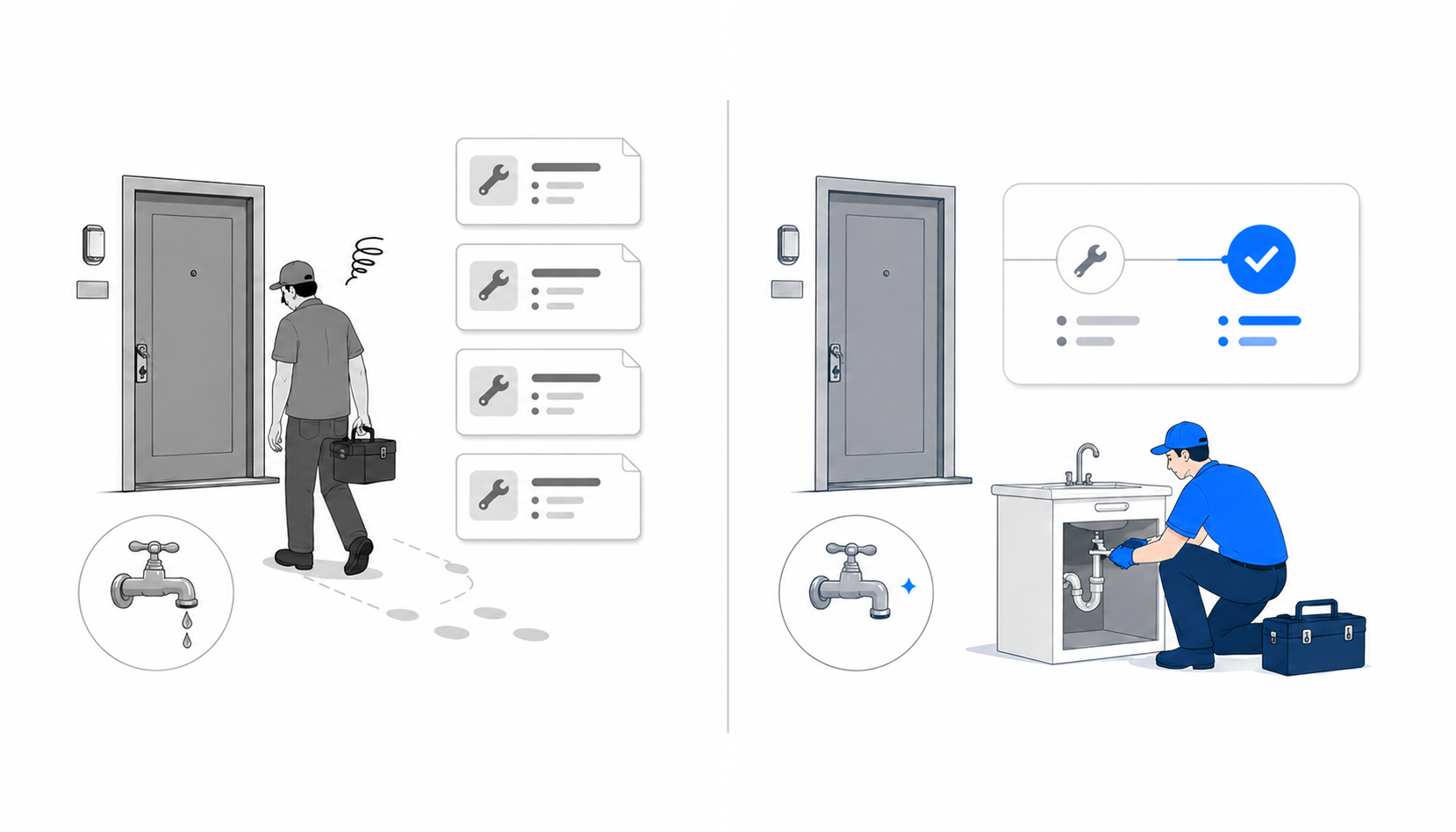
Repeat work orders. Past tickets sit beside the new one, so a repeat is flagged before anyone dispatches. Every patch you send instead of fixing the root cause is another vendor trip you pay for and more of your team’s time coordinating it. Catch it on visit two instead of four and you stop spending both.

Invoices. A router in front of AppFolio’s Smart Bill Entry catches invoices wherever they land, in vendor portals, on paper, or in one person’s inbox, reformats them, and hands them to AppFolio’s own reader so nothing slips a due date. The win here is cost, not minutes: independent research puts the average invoice at $9.40 and 9.2 days to process by hand, against $2.78 for teams that automate it.5 The routing itself saves an estimated 20 minutes a week per 100 units.

Owner and tenant updates. Drafted with context of the relevant history, ready to review and send. The win here isn’t just the typing time, it’s retention: AppFolio’s 2024 owner survey found communication is the top thing owners judge a property manager on, and that owners are three times more likely to consider leaving in their first year.6 An informed owner is one who renews. You also stop digging through old tickets and emails to piece together what happened before you write, which we estimate saves 20 minutes a week per 100 units.
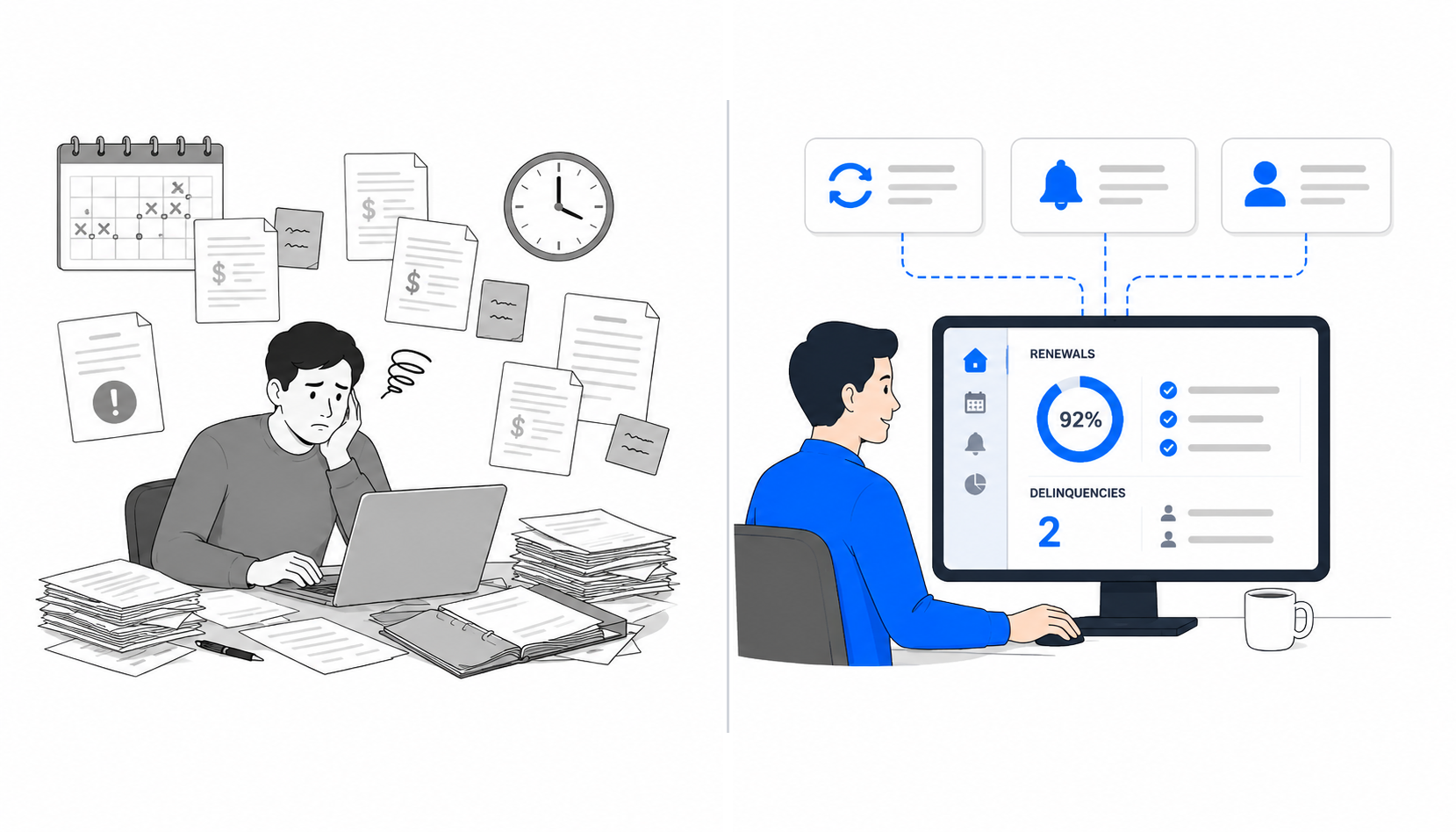
Renewals and delinquencies. Once a week you get a short rundown of what’s coming: who’s up for renewal, and who’s fallen behind, while there’s still time to act. A tenant caught 30 days behind is a phone call. Ignore it and it becomes an eviction, and economists studying rental ledgers put the cost of one at two to three months of rent, before the turn and the vacancy that follow.7 A renewal you see coming is a lease you keep instead of a unit you re-fill. The rundown itself saves maybe 15 minutes a week per 100 units, but the point is what it stops from slipping.
Add the timed pieces up and we conservatively estimate these automations can save an hour a week for every 100 units, and the repeat trips you stop coordinating push it past that. It climbs from there with your door count. But time is the smaller half. The repeat you fix instead of patch, the owner who renews, the delinquency you catch before it turns into an eviction: those don’t show up on a stopwatch, and they’re the ones that move the bottom line.
Nothing fires on its own. AI reads and drafts. A person reviews and decides. You keep the final say on anything that reaches an owner or a tenant.
Why not just switch, or just hire?
Those are the two usual moves, and both cost more than they look. Switching platforms takes months, and the data rarely comes over clean. The team loses weeks relearning everything, only to find gaps in what the new platform is capable of. Hiring is neither cheap nor steady: onsite turnover ran about 29% last year,8 and Gallup puts the cost of replacing someone at one-half to two times their salary.9 The system is the smaller bet, and it compounds. It runs every day, busy or quiet, and when someone leaves, the context stays in the system instead of walking out the door.
Where to start
Pick the most repetitive, black-and-white task you have, automate that one first, and keep a person reviewing the output. Once you trust it, move to the next.
If you’re a property manager feeling any of these limitations of AppFolio, book a call.
Sources
-
Upkeep Media, “Using AI to Run an 800-Door Property Management Company” (interview). youtube.com ↩
-
AppFolio, citing the 2023 AppFolio Property Manager Hiring and Retention Report: “an average of 15 hours per week can be optimized or streamlined through technology,” rising to 18 hours among companies with at least 10,000 units under management. appfolio.com ↩
-
VTS, “2025 Global Workplace Report,” a survey of more than 400 property managers and business leaders: 61% said most of their time goes to work order management, and 40% named invoice and payment processing a top time drain. vts.com ↩
-
AppFolio, “Realm-X Flows,” reporting a September 2024 survey of 343 Realm-X users who saved an average of 10.3 hours a week on to-do-list tasks and 11.9 hours on communication. Self-reported by AppFolio’s own users. appfolio.com ↩
-
Ardent Partners, “Accounts Payable Metrics that Matter in 2025” (drawing on a survey of more than 200 AP professionals): the average cost to process a single invoice is $9.40 and the average invoice takes 9.2 days, while best-in-class teams that automate run $2.78 per invoice. The full study is a paid analyst report; the figures here are as published by apexanalytix, which cites it directly. apexanalytix.com ↩
-
AppFolio, “2024 Real Estate Owner Preferences Report”: communication is “the top factor used to measure property management performance,” and property owners are “three times more likely to consider leaving their management company in the first 12 months.” First-party survey; AppFolio does not publish its methodology. appfolio.com ↩
-
Humphries, Nelson, Nguyen, van Dijk, and Waldinger, “Nonpayment and Eviction in the Rental Housing Market,” NBER Working Paper 33155 (2024, revised 2025): “filing an eviction costs landlords the equivalent of 2-3 months of rent.” A working paper, not yet peer-reviewed. nber.org ↩
-
National Apartment Association, “Why Employee Retention Challenges Go Deeper Than Wages” (reporting the 2025 RCLCO and CEL National Real Estate Compensation and Benefits Survey, which put onsite property-level turnover at 29.2%). naahq.org ↩
-
Gallup, “This Fixable Problem Costs U.S. Businesses $1 Trillion” (2019): “The cost of replacing an individual employee can range from one-half to two times the employee’s annual salary.” gallup.com ↩